Screw piles are the cleanest way to put house extension footings in beside an existing home, because they found new structure without excavating next to old footings or benching a slope. Engineered steel piers are wound in with compact machines that fit where a concrete crew and pump cannot, proof-tested by torque as they go, and cut to height ready to build on the same day. For the self-employed builder on a tight or sloping block, that means no undermined footings, no benching bill, and a certified foundation without the mess. New to the method? Start with our guide to what screw piling is and how it works.
House extension footings and foundations
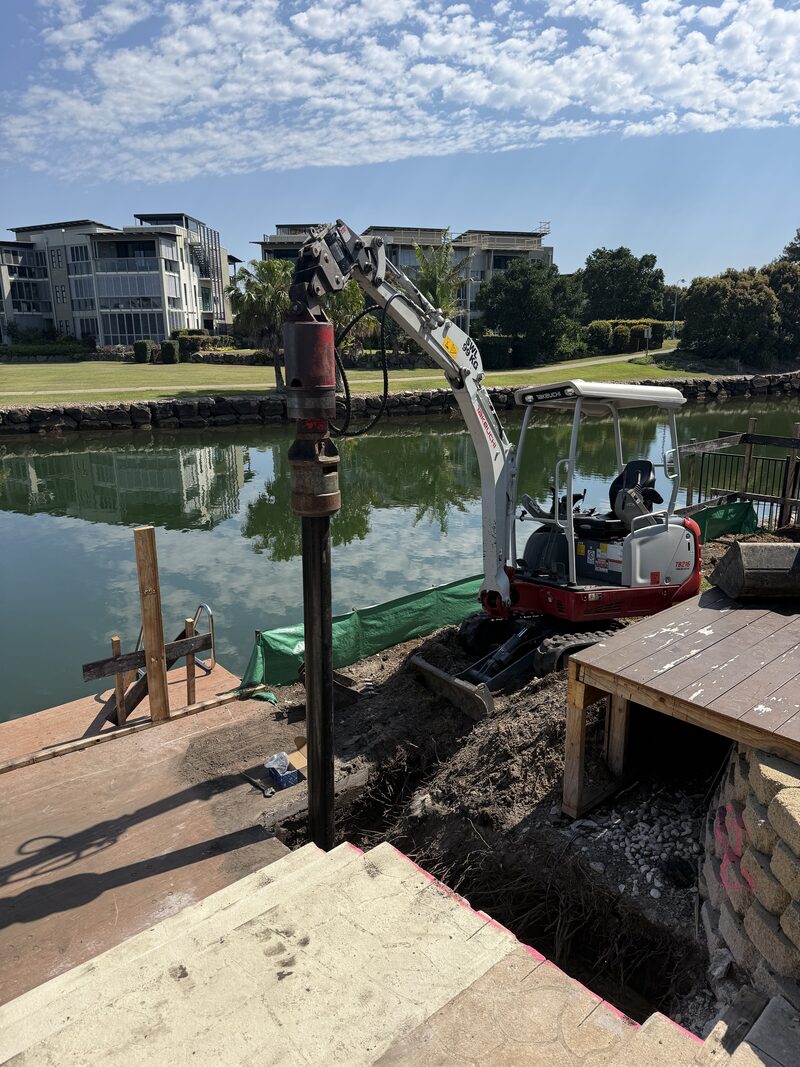
Extensions are where screw piling quietly saves a job. House extension footings have to go in right beside the existing house, and excavating a trench next to an old footing risks undermining it. Screw piers install with no open excavation against existing foundations, and the compact drive equipment works in spaces a concrete crew cannot get to.
Extension foundations for raised extensions and second-storey additions carried on posts are engineered per post load, which usually means fewer, better-placed foundations than a strip footing, and each one is load-cell tested and certified for the certifier.
Sloping and difficult site foundations
We are based at Woombye in the Sunshine Coast hinterland, so steep and awkward blocks are everyday work, not a specialty surcharge. On a sloping site, dug footings mean benching, retaining and enormous concrete volumes. Screw piles skip all of it: piers are installed at natural ground level down the slope, and the structure, deck or pole home is carried on posts above.
Many hinterland and coastal escarpment blocks are AS 2870 Class P (problem) sites, where standard footing tables do not apply and every foundation needs specific engineering anyway. Screw piles are usually the most economical engineered answer, and after over a decade reading South East Queensland ground we know how a given block is likely to behave before we quote it. Our guide covers Queensland soil classifications in plain English.
Decks, sheds and retaining walls
The same speed and access advantages carry across the smaller structural jobs that come with a renovation:
- Decks and pergolas: screw piles for decks are light-duty deck piers engineered for the actual deck loads, in within hours with a bearer bracket on top, and no stump holes to auger through clay.
- Sheds, studios and carports: piers under a slab or steel floor frame give a shed the same engineering integrity as a dwelling, without over-excavating reactive clay that would crack a thin slab.
- Retaining walls: deep, load-cell verified anchorage founded below the active soil zone, as vertical support and as tie-back anchors resisting the lateral push of retained ground.
How it works, start to finish
Send the job
Plans, or photos and a description with your access. We talk through whether screw piles suit the site.
Site assessment
We check soil, slope, access and any existing structures nearby, and arrange a soil report if there is not one.
Your quote
One clear price, piles installed and certified, to design depth with a rate if we go deeper. No hidden allowances.
Installation day
Piles wound in, torque logged on every one, cut to height. Most jobs are finished within a single day.
Certified handover
Torque records and engineer certification (Form 43) handed over, ready for the next trade to start.
Why screw piers on these jobs
- No undermined footings. New piers go in beside the existing house with no open excavation against old foundations.
- No benching bill. On a slope, piers found at natural ground level instead of cutting and retaining the block.
- Access other systems cannot reach. Compact machines work down the side of a house and into tight backyards.
- Proven and certified. Every pier load-cell tested as it goes in, then certified. Read when screw piles are the wrong choice.
Costs are covered honestly in our guide: see what screw piling costs in Queensland, including the factors that move the price.
Extensions & difficult site FAQs
Can you pile right beside an existing footing?
Yes. That is one of the main reasons builders use screw piers on extensions: they install with no open excavation against the existing foundation, so there is no risk of undermining it. Each pile is engineered for its post load and certified.
Can you get a machine into a tight or sloping block?
Almost always. Our compact plant fits through standard side access, and genuinely awkward corners can often be reached with smaller hand-guided drive equipment. Send photos of the access with your enquiry and we will confirm straight away.
Do difficult sites cost more?
Access and depth drive the price, so a steep or tight block can take longer than a flat one. But compared with benching, retaining and the concrete volume a slope needs for dug footings, screw piles are usually the cheaper engineered answer. You get a quote either way.
Do you also do granny flats and underpinning?
Yes. See our granny flat foundations and underpinning and foundation repair pages for those specific jobs.